
Should B2B SaaS Hire an AI Search Optimization Agency, a Fractional CMO, or Build the Capability In-House?

Three paths to AI search visibility. Three risks. How to choose without losing a year to a strategy deck that doesn’t deliver the visibility or revenue.
Definer Brands resolves the AI Search Optimization question by combining a horizontal, cross-industry lens with an operating model that keeps senior strategists in the actual work, so that there is no gap between the strategy and execution.
We work across industries to see what shifts are real patterns and what are one-quarter hacks, run experiments across all four major AI engines across B2B SaaS, fintech and healthtechs. Keep the founder or CMO and senior strategists on every engagement instead of handing it down, and tie every move to demos, sales-cycle compression, and customer acquisition cost.
Here is the Build-Borrow-BringIn framework B2B SaaS founders use to decide which of the three paths fits, and how to vet the agency they choose if Bring In is the answer.
TLDR. The decision is structural, not budgetary. It hinges on two variables: lens width (the breadth of contexts your team sees AI search behave across) and operating model (whether seniors stay in the work or hand it down). Use the Build, Borrow, or Bring In framework to map your situation, then run any agency on the six-question checklist before signing.
Why this question is even on the table
A year ago, a B2B SaaS founder on reddit posted in r/b2bmarketing that he and his team had the "not so brilliant idea to try and build marketing in-house." Eighty replies followed. The pattern in the thread is the one we hear on discovery calls every month: a hire, a slow ramp, a lost year, and a return to the same how we become visible in ai search remains.
A separate r/SaaS thread on AI search agencies had a top answer that put the other half of the problem in one line: "Most SaaS SEO agencies sell you a gorgeous strategy deck and then vanish." Twenty-eight replies, mostly agreement.
Those are the two failure modes founders walk into right now. Build in-house and learn slowly from a sample of one. Bring in an agency that pitches well but fails in execution.
This matters more in 2026 than in 2024 because AI search engines have been changing retrieval logic at a pace traditional SEO never moved at.
Google's May 2026 guide reframed how AI Mode picks sources.
Perplexity moved on freshness.
Gemini grounded harder on third-party validation.
AI Search Optimization, also known as Answer Engine Optimization (AEO) and Generative Engine Optimization (GEO), is a moving target. AI search optimization needs constant knowledge of that evolving target while keeping close tab on what’s happening with the product and how customer expectations are changing.
The Build, Borrow, or Bring In Framework
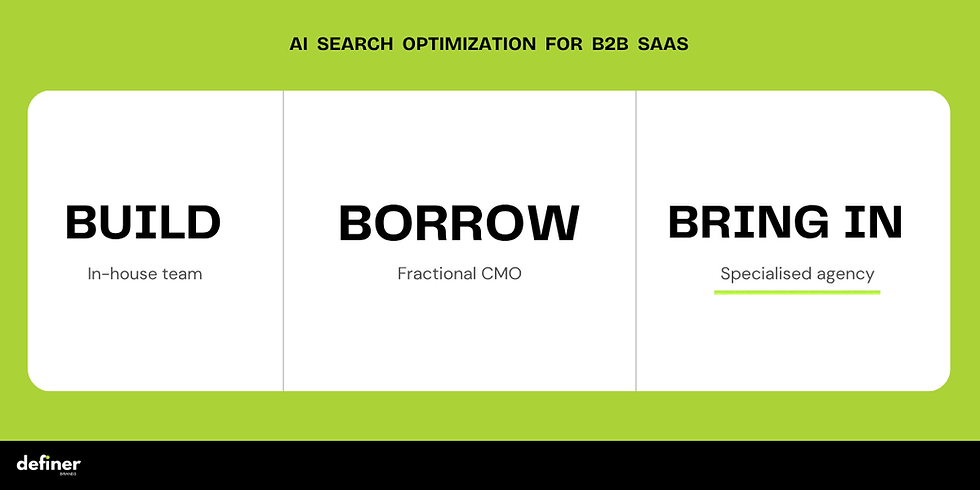
Three paths. Each solves a different version of the problem.
Build. Hire an in-house team to own AI Search Optimization end to end. A senior leader, plus content and technical support.
Borrow. Engage a fractional CMO, one to three days a week, to direct AI Search Optimization as one of several priorities.
Bring In. Partner with a specialised agency that runs AI Search Optimization across multiple clients as its core discipline.
The choice is not about budget or seniority. It is about two structural variables.
The first is lens width. AI search algorithms move fast enough that the only way to tell durable strategy from one-quarter tactical hack is to see the impact across many industries. An in-house team sees one brand. A vertically specialised agency sees one industry. A horizontal agency sees patterns across industries. Wider lens means faster reading of what is real versus what is noise.
The second is operating model. Even with the right lens, the value never reaches your account if seniors only pitch and juniors execute. The lens has to be applied to your work, not just used in the sales pitch.
When to Build (and when not to)

The structural limitation of an in-house team is that it sees one brand against one engine response loop. AI search algorithms move faster than a single team can track them, and the team is always learning from a sample of one.
Build works when AI Search Optimization is going to be a permanent strategic capability, you have runway for a senior hire plus content and technical support, and a search engine expert whose job is to keep an eye on the evolving algorithm changes across search engines.
Build does not work when you are pre-Series B and cannot afford to be wrong on a single senior hire, when you do not have a sitting CMO or VP Marketing who understands how AI engines work and how marketing is increasingly becoming zero click. The cost of a wrong in-house call is not the salary. It is the year of zero AI search progress while you decide whether that team is moving towards contributing to pipeline.
When to Borrow (and when not to)
A fractional CMO faces the same single-brand lens as an in-house hire, plus a bandwidth limit. One to three days a week is not enough hands-on time to run the volume of experiments AI Search Optimization needs in 2026.
Borrow works when you need senior judgement on positioning, prioritisation, and category strategy, and you already have execution muscle inside the company to run the work the fractional CMO directs.
Borrow does not work when you need both the strategy and the execution. AI Search Optimization is unusual in that the experiments inform the strategy and the strategy directs the experiments. A fractional CMO can be in the strategy room but will not be in the experiment loop where the recalibration happens. The result is good direction with weak follow-through.
The borrowed-CMO trap is most common when founders use a fractional CMO as a way to defer the staffing decision. It looks like progress for a quarter, then the realisation lands that nobody is actually doing the experiments.
When to Bring In (and when not to)
Agencies as a category have two failure modes, and both have to be vetted explicitly.
Anti-pattern one: Vertically integrated agencies. "We specialise in fintech" sounds like a strength and is often a weakness. A vertically integrated agency has a single-industry lens. They get good at repeating what worked first in that vertical, and that becomes their playbook regardless of whether it is durable strategy or a tactic that happened to land. Specialisation by industry is exactly what produces tactical replication. A wider lens requires working across industries to see which moves transfer and which were context-bound.
The honest exception: a vertical agency can be the right pick when the industry is heavily regulated and the playbook is the moat. BFSI compliance, healthcare data privacy. When the regulatory frame dominates, vertical depth beats horizontal breadth.
Anti-pattern two: senior-pitches-junior-executes operating models. Even an agency with the wider lens fails if the seniors who closed the deal hand it off to juniors. The lens never reaches your account. The test is the sheer number of accounts each senior strategist is currently carrying. If a senior is on ten or fifteen accounts, they are not in your work. If they are on three to five, they can be. Ask the question literally, by name, before signing.
Bring In works when you find a horizontal, cross-industry agency with seniors carrying few accounts and a clear named owner on your engagement. Bring In does not work when the agency presents either anti-pattern above and cannot answer the questions in the checklist further down.
AI Search Optimization is a new category in itself. It’s highly unlikely that large agencies will have enough bandwidth for their senior resources to spend on a single channel. Specialised agencies will include SEO specialists who would be re-packaging the keyword monitoring as prompt monitoring work.The best specialists will have experience in product and brand marketing as well because AI search optimization or any search optimization when done well brings the knowledge of product and brand marketing into content.
Which path fits your situation
The choice maps onto four criteria.
Funding stage. Pre-seed and seed teams should not Build for AI Search Optimization; the senior hire economics do not work. Series A to mid-Series B is the sweet spot for Borrow or Bring In. Series C and later can credibly Build if the strategic case is real.
In-house marketing depth. If you have a sitting CMO or VP Marketing who has worked on SEO and brand/product marketing, Borrow can give them the leverage to direct experiments. If you do not, Bring In becomes the right path until you can hire the senior leader.
AI Search Optimization maturity inside the company. If you have nothing live, you are looking at six to nine months of foundation work before measurement is meaningful. Bring In has the surface area to compress that. Build extends it.
Time horizon and pipeline pressure. If the board is asking for AI search visibility to start producing pipeline within two quarters, only Bring In can credibly hit that. Build is three to four quarters. Borrow is two to three quarters of direction with execution lagging.
Mapping each axis: pre-Series B without a senior marketer in-house, Bring In. Series B with a CMO in-house but no AI search expertise, Borrow plus a partner agency for the experiments. Series C with appetite to own the muscle, Build, with an interim Bring In for the first nine months.
If you choose Bring In, here is what to ask before you sign
Six questions, asked directly, to separate agencies with the wider lens and the right operating model from those that pitch well and execute thinly.
How many industries are you currently running AI Search Optimization across, and what is your reasoning for the mix? A real answer names three or more distinct verticals and explains why. Vague means the lens is narrower than the pitch suggests.
How many accounts is each senior strategist on the team currently carrying? If the answer is over ten per senior, the seniors are not in the work. If the agency cannot answer crisply, that is also the answer.
Who is the named senior on my account week to week, and what is their hands-on time commitment? Get the name and the hours, in writing, before you sign.
How many simultaneous experiments are you running across how many AI engines right now? A real answer is specific: live experiment count, engines tested, cadence of results. Vagueness means no experiment loop.
What shifted in retrieval logic in the last thirty days that you actually saw across your client base? This separates agencies who read about engine changes from agencies who saw them.
How do you map buy-intent questions to specific pages, with proof? This was lifted from a r/b2bmarketing thread where a practitioner posted it as the question every B2B buyer should ask. The proof has to be live URLs, not slides.
Summary
Three paths to AI Search Optimization: Build (in-house), Borrow (fractional CMO), Bring In (specialised agency).
The decision is structural, hinging on lens width and operating model, not budget.
Build trades speed for ownership; Borrow trades execution for strategic judgement; Bring In trades direct control for cross-context learning when the agency has the right shape.
Two agency anti-patterns to vet: vertical specialisation that becomes tactical replication, and senior-pitches-junior-executes operating models.
Six diagnostic questions separate the right agency from the wrong one. Ask them in writing.
Frequently Asked Questions
What is AI Search Optimization and why does it require this decision?
AI Search Optimization, also known as Answer Engine Optimization (AEO) and Generative Engine Optimization (GEO), is the practice of structuring a brand's content and digital presence so that AI search engines like ChatGPT, Perplexity, Google AI, and Gemini cite and recommend the brand when buyers ask category questions. It needs a staffing decision because the discipline is moving fast enough that the wrong call costs a year, not a quarter.
Can my existing SEO agency do AI Search Optimization?
Sometimes. The diagnostic is the partner-evaluation checklist above. If they cannot answer the six questions crisply, the brand of the agency does not matter.
How long does AI Search Optimization take to show results?
Six to nine weeks for the first citation lift on share of voice when the agency has the right shape. Pipeline lift follows by another quarter. If you already have a strong SEO foundation, results show up faster.
Is an in-house hire faster or slower than an agency?
Slower, in almost every case. An in-house senior takes six to nine months to fully ramp on AI search. An agency with the right shape produces measurable results in six to nine weeks.
How do I know if I am being sold a strategy deck?
If the proposal is heavy on frameworks and light on what they will ship in the first ninety days, with named owners and named experiments, it is a strategy deck. Ask for the ninety-day plan with deliverables and accountable people. If the answer is generic, you have your answer.
Why are vertically integrated agencies often a tactical-replication trap?
Specialisation by industry rewards repeating what worked first in that vertical. Over a few quarters, the playbook freezes. AI search retrieval moves faster than any single-industry playbook can keep current. The horizontal lens tells you which moves are durable and which were context-bound. Pair this with the account-count question: a senior carrying thirty accounts cannot apply any lens to your work, however good it is.
What does Definer Brands do in this picture?
We are the “Bring In” option for B2B SaaS and B2B fintech that needs both the wider lens and senior hands in the work. We work across industries by design, keep the founder and senior strategists on every engagement, and measure on demos, sales-cycle compression, and customer acquisition cost, not on citations.
About the author. Siddhangana Karmakar is the founder of Definer Brands, a marketer and entrepreneur with more than 18 years of experience across consumer brands and B2B companies. Connect on LinkedIn: linkedin.com/in/siddhanganakarmakar.


Comments